Posts tagged: LWB

LWB and Ranganathan’s Laws of Library Science

Librarians all over the world celebrate S. R. Ranganathan, whose Five Laws of Library Science, developed in India in the early 1930s, remain the code of honor that librarians live, and practice, by.

Ranganathan was born in a small town in British-ruled India, initially studying and teaching mathematics. When the University of Madras created a University Librarian position, Ranganathan studied up (via the Encyclopedia Brittanica), and impressed the University enough to be offered the position. To gather more information on his new profession, Ranganathan travelled to University College London and became immersed with developing a new, simpler system of book classification. The outcome was the system of colon classification, still in use today.

Ranganathan’s return to India coincided with the release of Mahatma Gandhi from prison, and, after his time studying Western librarianship in London, Ranganathan developed his Five Laws of Library Science. The laws were, and remain, significant for their focus on open, equal access to library services for everyone. The laws are:

Books are for use.
Every reader his [or her] book.
Every book its reader.
Save the time of the reader.
The library is a growing organism.

LWB, as a group that strives to improve access to information resources regardless of language, geography, or religion by forming partnerships with community organizations in developing regions, embraces Ranganathan.

Join us on Facebook over the next few weeks as we explore Ranganathan’s Five Laws through the work of LWB and our partner programs. Open access, in action.

FacebookTwitterShare...

Getting to Know Librii’s David Dewane

David DewaneLibrarians Without Borders recently had the pleasure of catching up with David Dewane, Founder and Executive Director of Librii, an LWB partner program working towards opening its first library in Accra, Ghana. Dewane opened up about Librii’s humble beginnings, the research and thought that goes into an undertaking of this magnitude - in a foreign country no less - and how LWB was instrumental to the process.

***

You might be surprised - and, if you’re also a student, encouraged - to learn that LWB partner program Librii, the library “specialized to meet Africa’s information demand with educational services, high-end digital resources, and books” originated as a graduate student project at Rice University. “I was researching areas where physical space, people and information mingle, and what that means in the age of digitizing information,” David Dewane remembers. “The library was the typology where this should be happening, as the place where people and information come together.”

Dewane’s train of thought lead him to really consider the space of the library in the shifting wide web world. Who has access to information? And how do they get it? A breakthrough came when he concluded that “libraries are no longer just places where people come to get knowledge in a contemplative way; they are places where people come to make things.”

“It was such a radical idea!” Dewane adds. “And such a notion of the library as at one time being a collection of resources, but also the building that houses them. And beyond collection and building, a space - that libraries are spaces that serve the human desire for collectivity. I love the idea of the persistent desire for collectivity, despite the web making things less necessary for collectivity. Libraries are more crucial than ever.

To aid in his library/space question, Dewane turned to the trusted source that all of us eventually seek out in the throes of a research question: a Rice University librarian. Soon Dewane brought together all his research into a plan for an actual library space. And then things aligned in his favor: a World Bank competition came across his path at that moment, allowing Dewane to gain a small development grant, but more importantly, some major interest in the project, initially titled Libraries Across Africa.

The idea was to develop libraries in India, a country Dewane was familiar with. But with the inclusion of the World Bank resources, and after researching important key factors including an analysis of language, ease of doing business, and freedom of press, African countries came to the forefront. Dewane explains that things finally came down to Ghana or Kenya, but confirms, “West Africa just felt right. It was a mix of intuition and objective subjective rational.” Africa, and Ghana in particular, also captured Dewane’s imagination with the continent’s narrative regarding the digital divide. “The expansion of fiber optics into sub Saharan Africa took place in 2009-2010 when the first cable landed there. It was mind blowing to realize they were just getting broadband!”

And that’s when it all conceptualized into the Librii we know today: a concept inspired by the prolific building spree of library hero Andrew Carnegie, who, between 1883 and 1929 helped create 2509 libraries throughout the world. But what Dewane admires most about Carnegie was his motive for helping communities obtain a library of their own. “This is a very clear and present model. It’s a massive scale, and hardly anyone ever talks about it. 2500 libraries over 30 years means opening a brand new library every five days! They were everywhere in the English speaking world, and in the Pacific Rim…Carnegie didn’t want to give food or medical aid, the basic aid philanthropy: he wanted to meet people halfway and provide tools to industrial people.”

The Carnegie Formula became the standard for communities requesting funds to build a public library. It required that they demonstrate the need for a library; provide a building site; come up with ten percent of the cost of the library’s construction to support the operation costs; and provide free service.

“Carnegie started listening more to librarians about how libraries should function: in the middle of the community, allowing people to access materials themselves, expand the collection to serve everyone - including women & kids - and give free service to all. One of the components for Carnegie building the library was that you prove that your community actually needed one. The Carnegie formula was how you built libraries.

Once Librii decided on Ghana as the first locale for its library, LWB and Librii partnered up, with LWB providing key research into the potential library users. “The partnership is incredibly valuable and generated very helpful reports that Librii couldn’t have done in-house,” Dewane says. As Librii gets closer to implementation, develops a training regime for the on-site librarians, and works through the ethical concerns facing a new library, LWB’s support will be crucial. “We need help from librarians. People like knowledgeable, credible librarians.”
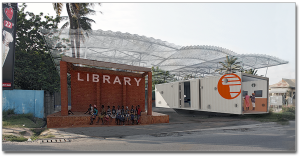
OxfordStreetMockLibrary2

Artist mock up of Librii’s library in Accra, Ghana.

Still needed are more generous donations. Then Librii will be on track to pack up, ship, and open its first library in Accra, providing students and working adults with a space to find information, and strengthen the knowledge of the community.

FacebookTwitterShare...

¡Ayuda a Bibliotecarios Sin Fronteras a conocer tu biblioteca!

Librarians Without Borders está interesada en comprender las necesidades de las bibliotecas en países en vías de desarrollo, especialmente en lo referente a la gestión de sus colecciones. Hemos creado un breve cuestionario para recabar información sobre la realidad de su biblioteca y de esta manera saber cuáles son los problemas más comunes a los que se enfrentan las bibliotecas que necesitan ayuda en todo el mundo.

Su información nos ayudará a desarrollar herramientas para ayudar a nuestros socios y amigos para que puedan dirigir sus bibliotecas. Sus conocimientos y punto de vista profesional son de extremo valor por lo que le agradeceríamos si pudiera regalarnos 20 minutos de su tiempo para compartir con nosotros información sobre su biblioteca.

Si tiene alguna pregunta, por favor contacte con Carmen Ho ([email protected]) o Stephanie Osley ([email protected]).

El plazo para completar la encuesta es el domingo, 07 de diciembre de 2014.

Haga clic aquí para empezar.

Gracias por su valiosa contribución a nuestra labor y por favor, comparta el cuestionario si conoce a alguien más que pudiera ayudarnos!


spanish survey

FacebookTwitterShare...

Getting to Know LWB: The Interns

This year, Librarians Without Borders joined forces with San Jose State University (SJSU) in California to offer a service-based learning-model Virtual Internship program. Three students working towards Masters in Library and Information Science at San Jose State’s i-School are interning as Program and Communications Assistants with LWB’ers Melanie Sellar, Founder and Co-Executive Director; Erika Heesen, Membership Director; and Brandie Burrows, Guatemala Limitless Horizons Program Manager. Using all of the virtual tools at their disposal - Skype, WebEx, Google, Only Office, good old phone calls - the interns are hard at work on projects including providing research assistance in support of the new emerging program with Limitless Horizons Ixil in Guatemala, and developing a communications/social media strategy for the group. We’ll be chatting, Q&A style, with each of the three students over the next few weeks, to get to know the LWB Interns.

Maryanne Daly-DoranMaryanne Daly-Doran, Communications Assistant Intern.

What was it about LWB that drew you to the internship? In my position at the Hartford Public Library, I developed a special interest in the many pre-literate and non-literate (individuals who either speak a language that has no written form, or are illiterate in their native language) individuals who struggle with the literacy component of the naturalization exam. Working with so many individuals who come from countries with little or no library culture led me to evaluate how I had taken the free public libraries in the U.S. for granted. I often times wonder what my life would be like if there were no libraries? Imparting knowledge to an individual is so empowering, I knew when I heard about LWB that I wanted to be a part of it and its mission. I loved the idea of LWB’s service learning model and its goal of narrowing the information divide by supporting librarians in developing countries. To learn about international librarianship has been just an exhilarating experience.

Is this your first internship? How do you find the virtual part? This is the first internship I have participated in at SJSU. I have found the virtual aspect to be very flexible and instructional as well. I love the regular check-ins with Melanie Sellar and Erika Heesen and their support of our learning experience as well. It is so amazing that there are so many ways to communicate and if one doesn’t work, there are always alternatives. I have learned much about collaboration and my technological skills grow by the day.

What was your experience with social media prior to this internship? How has working with LWB changed your thoughts or approach to social media? Admittedly, my experience with social media prior to this internship was limited to my personal Facebook account and the development of a few Facebook pages for some local school based organizations. Working with LWB has made me realize how important it is to understand how the use of various social media tools bring value to the non-profit organization. Social media platforms promote non-profit organization’s information and services, as well as bring people of similar interests together to network. In developing Best Practice recommendations, I was invited to be an analyst and was able to compare and contrast similar pages as well as to watch the impact of different posts and methods. I feel I gained invaluable experience first hand and have a much better understanding of strategy.

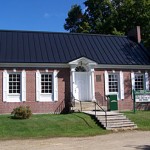
Weld Public LibraryWhat’s your favorite library, and why? What was your experience with this particular book home? My favorite library would have to be Weld Library in Weld, Maine (Population 340). It was at this library in this tiny town in the Appalachian mountains that I volunteered at the age of 12 with card cataloguing, thus initiating me into the world of libraries! It was in the stacks at this library that I became acquainted with the likes of Pearl Buck, Mark Twain, Tennyson and Poe. The fact that I was able to lose myself in the wondrous world of reading in this tiny, impoverished factory town during my vulnerable years makes this my favorite library, hands down.

What led you to San Jose State’s Library & Information Science program? Where do you see yourself, post-degree? As a child, I initially struggled to learn to read, I remember going into libraries with my mom and seeing the stacks of books that I wasn’t yet able to read. Fortunately, I had two parents who were library proponents and they instilled a love of books and libraries from a young age. When I finally mastered the skill of reading, I read everything I could find and have continued doing so throughout my life. I never take reading for granted and when I work with adults who are illiterate, I often wonder how my life would be if I was not able to read. It’s such a powerful question and I know I take the abundance of libraries in our country for granted at times. I initially entered Law School with the goal of working with underserved and vulnerable populations. While there, I always preferred time in the library over the class and never forgot this. When I was hired many years later at the Hartford Public Library as the program coordinator for the Citizenship Program, I realized how libraries affect change in the communities served. I was encouraged to pursue my MLIS and the online learning environment made it possible for me to realize my dream. My ideal job would be to work in literacy programming in underserved populations either here or somewhere else in the world.

What are you reading right now? I am reading two books (of course!). I am listening to The Garden of Burning Sand by Corban Addison and reading Mambo in Chinatown by Jean Kwok. I always have to be listening to a book on tape during my commute to work!

FacebookTwitterShare...

WordPress Themes